
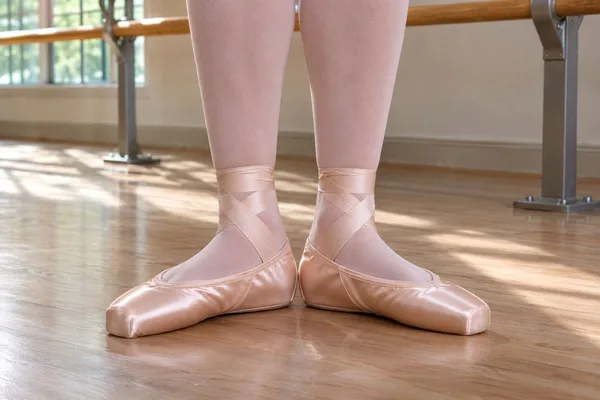
A child's age and enthusiasm don't determine if they are ready for pointe shoes, but rather their instructor's assessment of their readiness for the next step. At a Longwood dance studio that takes ballet seriously, that assessment looks at strength, technique, and steady training, not just how badly a dancer wants those pink satin shoes.
At Turning Pointe - A Dance Studio, we have been teaching ballet on Wekiva Springs Road in Longwood since 1996. Wondering where your dancer stands? Reach out to our team or call (407) 862-5500.
What Do Teachers Look For Before Moving a Dancer to Pointe?
Teachers look at strength, technique, consistent ballet training, and physical maturity together. No single factor decides it on its own.
Strength comes first. A dancer needs strong feet, ankles, legs, and core to rise onto pointe safely and come down with control. Teachers watch how a student holds relevé, how stable the ankles are, and whether the dancer can stay lifted through the whole body instead of sinking into the joints.
Technique matters just as much. Good alignment, a correctly held turnout, and clean, controlled movement in ballet slippers are the base pointe work is built on. If those habits are not solid on flat, they will only get harder to fix once the dancer is up on the box of the shoe.
Then there is consistency and age. Steady ballet training over time builds the strength and habits pointe needs, and a teacher also considers how a dancer's body is developing. These factors look different for every child, which is why there is no one-size-fits-all rule. Learn more about our ballet and pointe classes.
Why Is Moving Up Too Early Risky?
Because pointe puts a lot of demand on growing feet and ankles. A dancer without enough strength and control is more likely to strain or injure herself and to pick up habits that are hard to undo.
On pointe, the whole body balances on a very small surface. If the ankles roll, the knees twist, or the core lets go, that stress lands in the wrong places. Over time, that can lead to pain, injury, and setbacks that keep a dancer out of class.
Moving up too soon can also slow progress. A dancer who struggles to stay aligned on pointe may start sickling the feet or gripping with the wrong muscles. Those habits carry back into flat work and take time to correct.
There is a confidence side too. A dancer who is pushed before she is ready often ends up frustrated. Waiting until she is truly prepared makes the first pair of pointe shoes a milestone instead of a struggle.
How Does Our Dance Studio Place Dancers in Ballet and Pointe?
Our instructors place each dancer based on our curriculum and the dancer's ability. Pointe is part of our class lineup, and dancers move into it when their teacher sees they are ready.
That means placement is personal. Two dancers the same age may be in different classes, and that is completely normal. Our teachers watch each student in class, track how they progress, and decide on the next step with that dancer's safety and growth in mind.
Our ballet faculty brings deep classical training. Bevalie Pritchard trained at Atlanta Ballet, completed Vaganova pedagogy training, has taught American Ballet Theatre curriculum, and has worked with Orlando Ballet. Meet the rest of our dance faculty.
If your dancer has trained somewhere that never explained the path to pointe, that is a common story. We are happy to talk through where she stands now and what the next steps could look like.
How Can a Trial Class Help Your Dancer?
A free trial class lets a teacher see your dancer in person. It is the best way to get an honest read on her current level and the right class for her.
During a trial, the teacher can watch your dancer's strength, alignment, and technique in a regular class setting. Afterward, you can talk with the studio about placement, which classes make sense, and what she can work on to build toward pointe. Have her wear fitted dancewear and her ballet slippers so the teacher can see her alignment clearly.
Free trial classes are offered anytime, so there is no need to wait for a new session. Check our class schedule to find a ballet class that fits your week.
Ready for a teacher's honest take? Call (407) 862-5500 or contact Turning Pointe to schedule a free trial class and talk about ballet placement.